


Doctors, you’re busy.
Between patients, endless secure messages (argh!!) and being a parent, spouse, and friend, the last thing you want is a second job dealing with a broken toilet on weekends on your rental property.
I totally get it.
That’s why syndications appeal to so many physicians.
You invest, you forget, and let the experienced operator manage the property and hopefully make you some money while you can focus on everything else that matters.
Many syndications work out well, especially when the sponsor buys at a great price, manages the property effectively, and maximize rental income.
But there’s a question many physicians overlook:
How much of my investment actually makes it into the real estate itself?
The Fees You May Not Know You’re Paying
When you invest in a syndication, not all of your money goes toward buying the property.
Some of it pays the people who put the deal together and run it.
Here’s some common fees, with illustrative ranges.
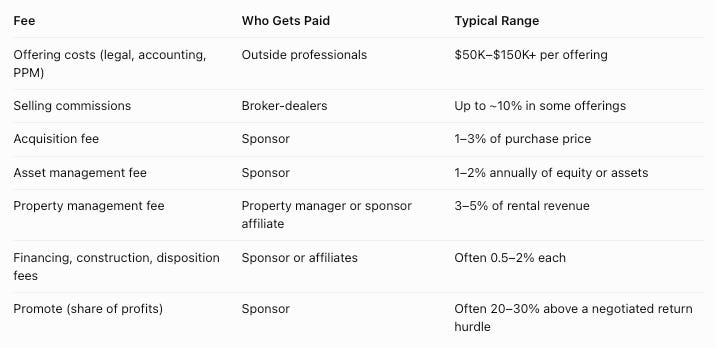
Two important points:
These ranges are illustrative, not industry standards. Fees and how they’re calculated, considerably from deal to deal.
None of these fees is automatically unreasonable. Sponsors deserve to be paid for finding, financing, improving and managing properties.
But you should know exactly what you’re paying for.
Where Did Your $100,000 Go?
Say a syndication raises $25 million from investors, and 12% goes towards offering costs, commissions and the sponsor’s acquisition fee.

For every $100,000 you invest, approximately $88k remains after those initial costs.
The other $12k pays for putting the deal together.
Here’s something that may surprise you.
The acquisition fee is usually calculated as a percentage of the property’s purchase price, not of the money investors put in.
Suppose the sponsor buys a $60 million property using $25 million of investor equity and financing for the rest.
A 2% fee equals $1.2 million.
That’s nearly 5% of the investor’s $25 million money, just for the acquisition fee!
Again, that does NOT automatically make it a bad deal.
But the property needs to generate enough value to overcome those costs before investors achieve their expected returns.
And remenber, ongoing management fees and the sponsor’s share of profits may come on top.
The Tax Surprise: Not Every Fee is Deductible
Many investors assume that if their money pays a business expenses, they’ll get a tax deduction.
Not always.
Under §709, syndication costs including commissions and expenses associated with marketing and selling partnership interests generally cannot be deducted or amortized.
Not this year.
Not over time.
Other expenses receive different tax treatment:
Organizational costs: May qualify for a limited immediate deduction, with the remaining eligible costs amortized over 15 years.
Property acquisition costs: Generally capitalized. Amount allocable to depreciable buildings or improvements may be recovered through depreciation, while land is not depreciable.
The lesson?
Not every dollar you invest generates a tax deduction.
And syndication costs are particularly important because they generally cannot be recovered through depreciation or amortization.
The Sponsor Can Make Money Even When You Don’t
Here’s another thing to understand.
How does the sponsor get paid?
Some fees are paid when the property is purchased.
Others are paid every year for managing the investment.
Many of these fees can be earned whether or not investors ultimately makes a profit.
Then, there’s the promote: it’s the sponsor’s additional share of profits under the deal’s distribution waterfall.
That can be a great incentive, because it rewards performance.
But the details matter:
Is the sponsor investing meaningful cash alongside you?
Is the sponsor’s ownership stake largely funded by fees?
How much does the sponsor earn before you receive your expected return?
You want a sponsor who succeeds when you succeed, not just because you invested.
Five Questions to Ask Before You Invest
Where does my money go? How much goes towards the property versus fees, reserves, and other costs?
Who gets paid? The sponsor, its affiliates, brokers, outside professionals?
How do they get paid? Regardless of performance, or only when investors profit?
How much is the sponsor investing? Is it real cash at risk?
What am I getting in return? Do the sponsor’s expertise, access, financing, and management justify the costs?
Most of the the answers should be in the Private Placement Memorandum (PPM), operating agreement, subscription documents, and financial projections.
But just because something is disclosed doesn’t mean it’s easy to understand.
And a PPM alone won’t tell you whether a deal is fairly priced
Syndication or Your Own Rental Property?
This isn’t an argument against syndications.
Owning a rental directly gives you more control.
But it comes with tenants (sometimes crazy ones!), repairs, and vacancies, financing and property management and sometimes some crazy drama!
A well-run syndication can give you access to larger properties and experienced management without becoming a landlord.
You’re paying for expertise, convenience, and access.
And that may be worth every penny.
The question is whether the deal still makes financial sense after all the fees.

The Bottom Line
Doctors, you work incredibly hard for your money.
Before handing $100k to someone else to invest, make sure you knwo where it’s going.
A great property doesn’t automatically makes a great investment.
The purchase price matters.
The management matters.
The financing matters.
And the fees matter.
My goal isn’t to steer away from syndications. Many can be excellent investment opportunities.
It’s to help you ask better questions.
Because understanding the numbers matters as much as understanding the tax benefits.
If you’re a physician considering a syndication and want a second opinion on the tax side, feel free to reach out.