


Wait, what?
Recently, I reviewed an operating agreement for a real estate syndication as a tax advisor.
I expected to see thoughtfully drafted partnership tax provisions that made sense for the deal.
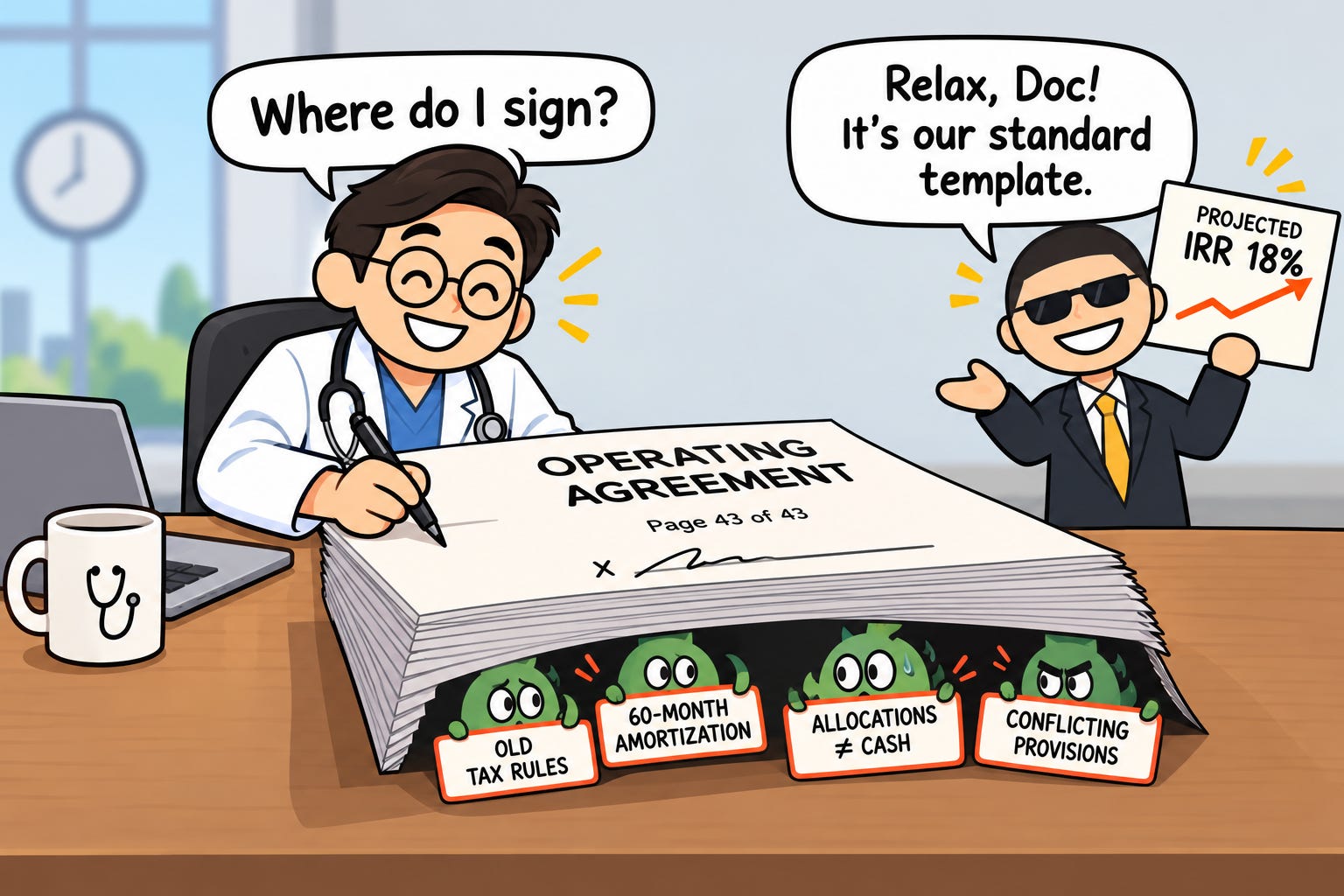
What I didn’t expect was to find outdated tax rules, provisions that didn’t seem to match the deal’s economics, and sections that appeared to contradict each other.
The surprising part?
This was an actual operating agreement prepared in 2026 for a nearly $20 million real estate syndication deal.
Now, I’m not saying this makes the investment a bad deal.
But if you’re a physician investing $100,000 or more, wouldn’t you want someone to catch these issues before you sign?
Let me show you three things I found.
#1. Tax Rules That Changed Years Ago
As I read through the agreement, I started noticing language that looked awfully familiar.
It appeared to be based on an old template.
How old?
Well, some provisions referenced tax rules that changed years ago!
For example:
Technical termination under IRC §708(b)(1)(B): This rule was repealed for partnership tax years beginning after December 31, 2017. Yet the agreement still referenced it.
Organizational cost amortization: The agreement referred to amortizing organizational costs over 60 months. But the law changed in 2004. Under current §709(b), qualifying organizational costs may receive a limited immediate deduction, with the remaining eligible costs amortized over 180 months (15 years).
Neither issue automatically means the investment is bad.
And outdated wording doesn’t necessarily mean investors will file incorrect tax returns.
But here’s my question.
If a document prepared in 2026 still contains tax rules that changed in 2004 and 2018, what else might have been overlooked?
That got my attention.
#2. The Tax Allocations Didn’t Seem to Match the Cash Distributions
This one concerned me more.
Two sections of an operating agreement are especially important:
The distribution waterfall determines who gets the cash. For example, after investors receive their preferred return and invested capital back, the remaining proceeds might be split 70% to investors and 30% to the sponsor.
The tax allocation provisions determine who reports the taxable income, gains, losses, and deductions.
Here’s the catch.
Who gets the cash and who pays the taxes aren’t always the same person.
Under IRC §704(b), tax allocations generally need to reflect the partners’ economic arrangement or otherwise satisfy the applicable tax rules.
In plain English, the tax allocations and the distribution waterfall need to work together.
Here’s how things can get messy.
Imagine the property is sold.
Cash is distributed according to the waterfall, but taxable gain is allocated using a different formula.
Depending on the circumstances, an investor or even the sponsor could be allocated $100,000 of taxable gain without receiving any cash from the sale!
Now, that doesn’t automatically mean something is wrong.
Depreciation, debt repayment, and timing differences can all cause taxable income on your K-1 to differ from the cash you receive.
The real concern is whether the tax allocations were properly designed to reflect the economics of the deal over its lifetime.
In the agreement I reviewed, those provisions didn’t appear to line up.
That’s something I’d want clarified before investing $100,000 of my hard-earned money.
3. The Agreement Contradicted Itself
Here’s another interesting finding.
One section said the partnership must make a §754 election when a member requests it.
Another section said the decision was up to the manager.
Wait a minute…
Is the election mandatory upon request, or is it the manager’s choice?
Those provisions appear to give conflicting instructions.
Why does this matter?
A §754 election can allow certain adjustments to the tax basis of partnership property when a partnership interest is transferred (such as through a sale or death) or certain distributions occur.
For example, if you buy another investor’s partnership interest, the election may allow a special basis adjustment that better reflects what you paid, subject to the applicable rules.
That can affect future depreciation deductions and taxable gain.
It’s not a minor issue.
And when two sections of the same agreement give different instructions, someone needs to clarify which provision controls.
Ideally, before anyone signs.
Why Does This Happen?
I don’t necessarily think someone was careless.
Here’s what I suspect often happens.
A sponsor has an operating agreement from a previous deal.
The document gets reused.
The property information changes. The investor names change. The numbers change.
But some of the technical tax language stays the same.
And everyone assumes someone else has already checked it.
I get it. These documents are long, complicated, and not exactly bedtime reading.
But remember:
An operating agreement isn’t just legal paperwork. It determines how your money, tax allocations, and investor rights are supposed to work.
And those details can matter long after you’ve made your investment.
Five Things I’d Do Before Investing
If you are considering a real estate syndication, here are five practical steps.
Read the distribution waterfall and tax allocation provisions together. Do they appear consistent with the deal’s economics?
Use AI for an initial review. AI can help identify outdated tax references, contradictions, and provisions worth investigating. But don’t assume every AI finding is correct.
Have a qualified tax professional review the findings. Preferably someone familiar with partnership taxation and real estate syndications.
Ask the sponsor questions. Was this agreement specifically updated for the current deal? Did tax counsel review the allocation provisions?
Resolve important issues before signing. It’s much easier to ask questions before investing than to deal with unexpected tax consequences afterward.
And one more thing.
Don’t assume that because an attorney drafted the agreement, every tax provision has been independently reviewed.
Attorneys have different areas of expertise, just like physicians.
You wouldn’t ask an orthopedic surgeon to interpret ST-segment depression in the inferior leads on an EKG, right?
The same principle applies to tax law.
The Bottom Line
Doctors, real estate syndications can be excellent investments.
I’m not suggesting otherwise.
But when you are investing $100,000, $200,000, or more, don’t focus exclusively on projected returns, depreciation deductions, and cash flow.
Take a close look at the document that actually governs the investment.
A well-written operating agreement won’t guarantee a profitable investment.
But an outdated or internally inconsistent agreement can create unnecessary tax questions and potential disputes.
And those are things I’d rather discover before writing the check.
Here’s a question for you:
If you’ve invested in a syndication, did anyone review the operating agreement for you before you signed?
If you are a physician considering a syndication and want a second set of eyes on the tax provisions, feel free to reach out.