


No one wants to get audited.
Especially when you’re already spending your evening answering an endless stream of patient secure messages.
My heart goes out to the PCPs!
Imagine getting an IRS notice when you already have so much on your plate.
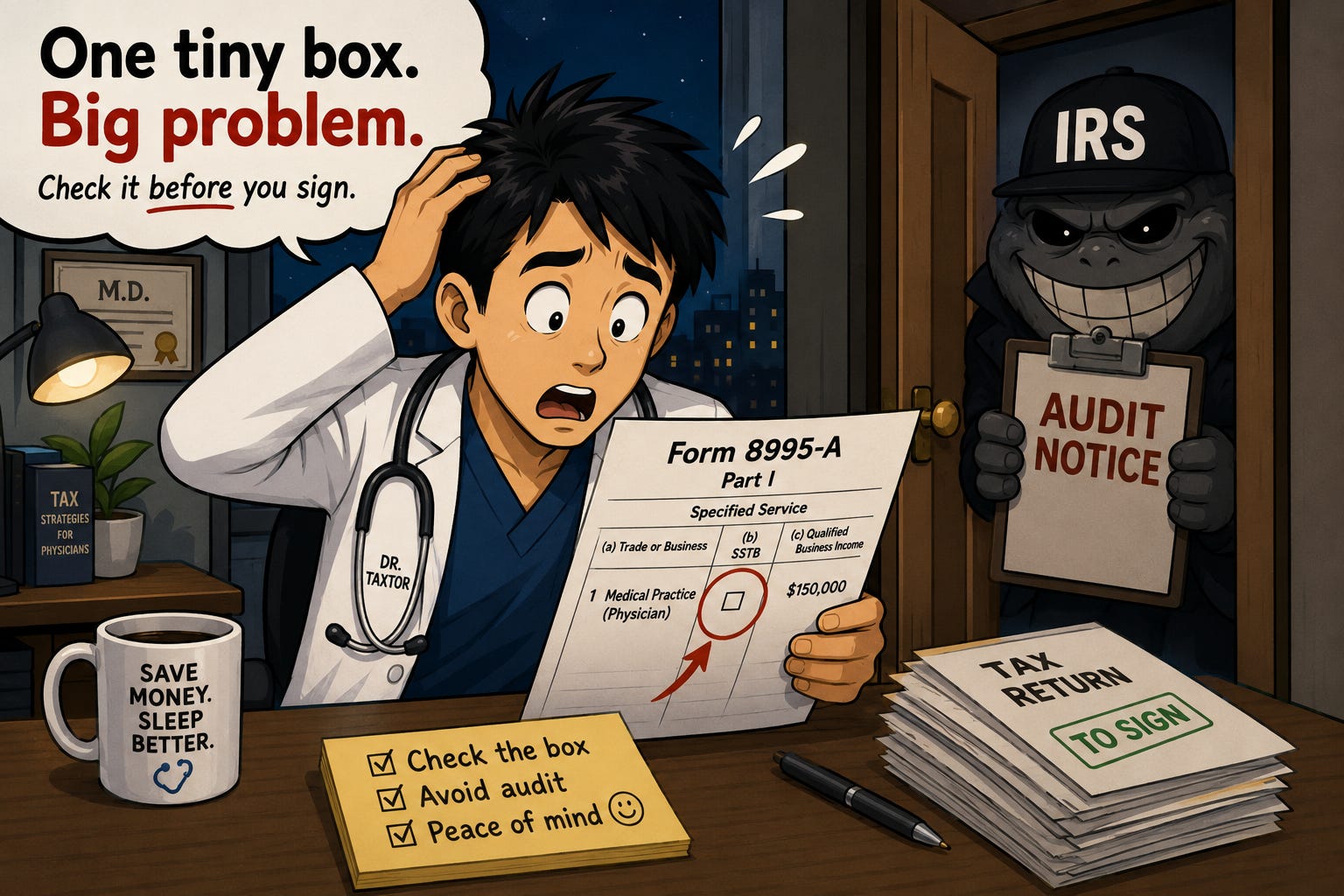
So let me give you one simple thing to check on your tax return before signing it.
It’s a tiny box on Form 8995-A.

And if your tax preparer leaves it blank when it should be checked, you could end up claiming a QBI deduction you weren’t entitled to.
That mismatch could draw unwanted IRS attention.
And that’s not the kind of surprise you want.
First, What Is QBI?
The Qualified Business Income deduction, or QBI deduction, can potentially allow eligible business owners to deduct up to 20% of qualified business income.
Sounds great.
Except physicians have a complication.
Medicine is generally considered a Specified Service Trade or Business (SSTB) under the QBI rules.
And Congress apparently decided that high-income doctors shouldn’t get the full QBI deduction!
Once your taxable income exceeds certain thresholds, the QBI deduction attributable to an SSTB begins to phase out.
Go high enough?
It disappears completely.
For 2026, the SSTB phaseout is complete once taxable income exceeds the applicable upper threshold for your filing status.
Married Filing Joint: $553,500
Single: $276,750
Because these thresholds are indexed for inflation, always make sure you’re looking at the numbers for the correct tax year.
For many high-income physicians, that means no QBI deduction from their medical practice.
The Tiny Box That Creates a Big Problem
This is one of the patterns I look for when reviewing physician tax returns.
Go to Form 8995-A, Part I, line 1.
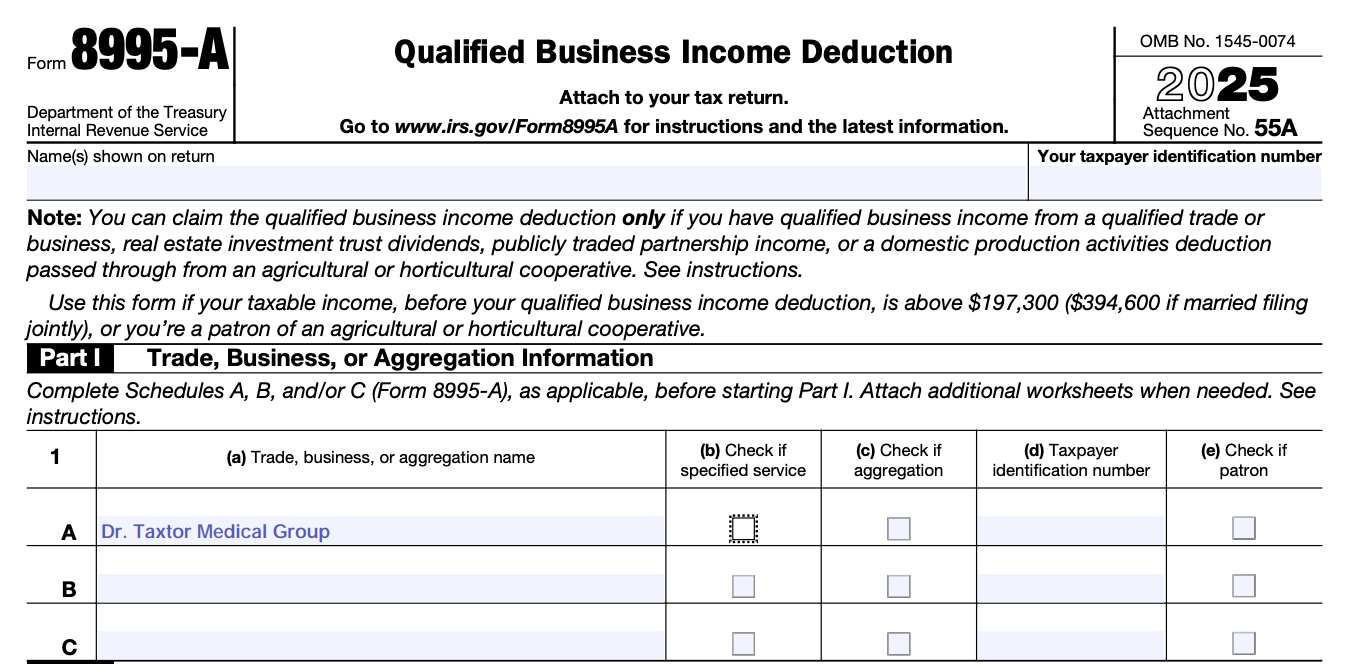
There’s a column labeled:
Specified Service
For a physician’s medical practice, that box generally needs to reflect that the business is an SSTB.
But too often...
it’s left blank.
And that little omission can have a big consequence.
The tax software may calculate a QBI deduction as though the physician’s practice were not an SSTB.
Suddenly, a high-income physician who otherwise may not qualify gets a nice deduction.
Free money!
Right?
Not exactly.
The IRS Already Knows You’re a Physician
This is where I’d get nervous.
Your tax return contains an enormous amount of information about you and your business.
The IRS uses automated systems to identify inconsistencies and potentially questionable positions.
So imagine what the return looks like:
Occupation: Physician
Business: Medical practice
SSTB: No
QBI deduction: Yes
Hmm...
That’s not a mismatch I’d want sitting on my tax return.
Does that mean checking the wrong box automatically triggers an audit?
No.
But an incorrectly claimed QBI deduction can create unnecessary IRS exposure.
And think about the trade you’re making.
You’re potentially creating an IRS problem...
over a deduction you may never have been entitled to take in the first place.
The 10-Second Check
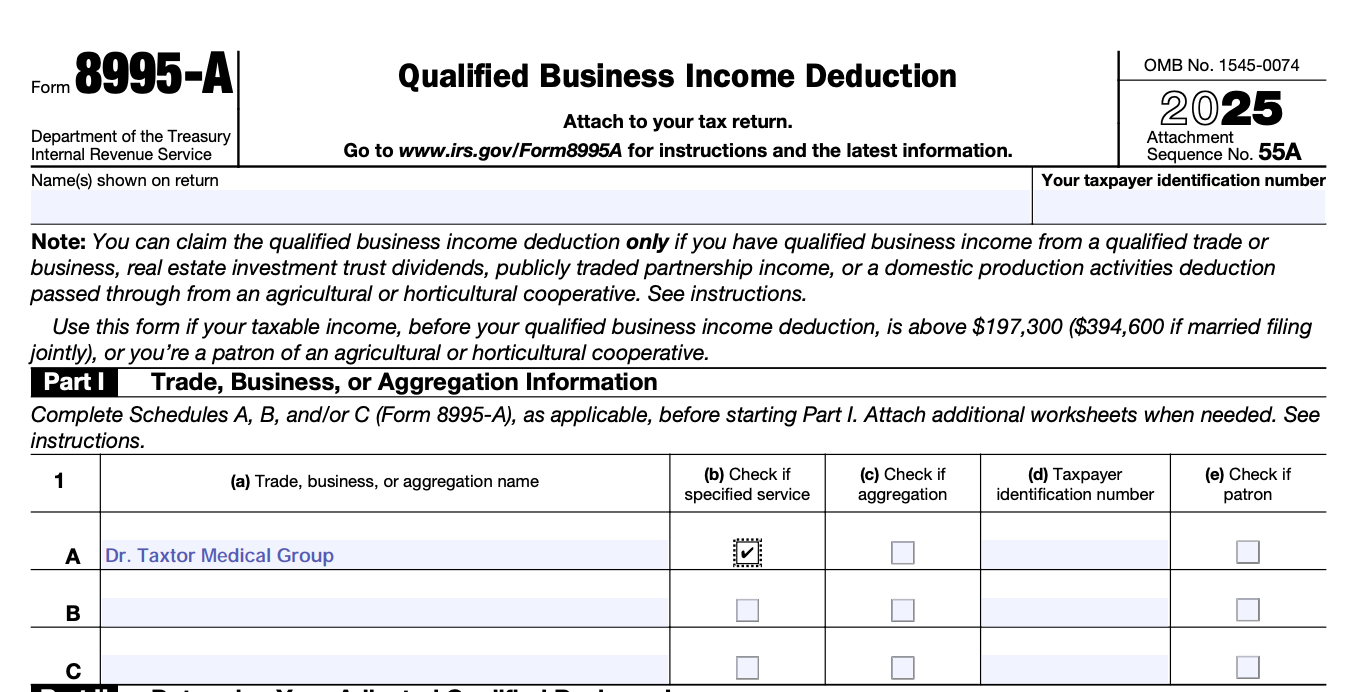
Before signing your return, pull up Form 8995-A if it’s included in your return.
Look at:
Part I → Line 1 → Column (b)
That’s the SSTB column.
If the business listed there is your medical practice, make sure its SSTB treatment is correct.
That’s it.
Ten seconds.
If something doesn’t look right, don’t immediately change the return yourself.
Ask your tax preparer why.
There may be facts specific to your situation that affect the calculation.
But you want that conversation to happen before you sign and file, not after an IRS notice arrives.
Important Exception: Not Every Health-Related Business Is an SSTB
This is where things get interesting.
A physician directly providing medical services is generally engaged in an SSTB.
But not every business that touches healthcare automatically becomes one.
The regulations distinguish between providing services in the field of health and operating certain health-related businesses.
For example, an ophthalmology practice may have a separate retail component selling eyeglasses, contact lenses, or other products.
That retail activity may be treated differently from the physician’s medical services, depending on the facts and how the business is structured.
So don’t oversimplify the rule to:
Healthcare = SSTB
A better way to think about it:
Physicians directly providing medical services are generally SSTBs. Health-adjacent businesses may be a different story.
That distinction can matter - a lot.
The Bottom Line
One thing I’ve learned from reviewing physician tax returns:
Small boxes can create very expensive mistakes.
Your CPA, EA, or tax preparer may prepare the return.
But you’re ultimately signing it.
You don’t need to understand every line of a 100-page tax return.
But you should understand the lines that can materially affect your taxes.
And for physicians with business income, the SSTB box on Form 8995-A is one I’d check.
📅 Are you a physician looking for legitimate ways to reduce your taxes?
Book a free tax-saving discovery call:
Book a free consultation with Dr. Taxtor
Disclaimer
This article is for educational purposes only and should not be construed as tax or legal advice. Eligibility for the QBI deduction depends on your individual facts, taxable income, business structure, and applicable tax law. Consult your own qualified tax professional before making changes to your tax return.